What matters
Compatibility standard
Make sure the plugs and couplers actually match across the setup.
Garage Bench Co.
Serious DIY garage workshop guidance
Buying guide
The best air fittings and couplers for garages match the hose, flow needs, tool use, and leak tolerance of the setup so compressed air feels less sloppy and more dependable.
Written by
Garage Bench Co. Editorial Team
Who this guide helps
Readers cleaning up small garage air systems, hose setups, and quick-connect choices for nailers, inflators, impact tools, or general compressor workflow.
Best use
Choose fittings and couplers based on compatibility, flow needs, leak resistance, and how often tools change. The best setup is one that seals well, swaps quickly, and does not accidentally choke the tools that need airflow.
Quick answer
Choose fittings and couplers based on compatibility, flow needs, leak resistance, and how often tools change. The best setup is one that seals well, swaps quickly, and does not accidentally choke the tools that need airflow.
Who this guide is for
Readers cleaning up small garage air systems, hose setups, and quick-connect choices for nailers, inflators, impact tools, or general compressor workflow.
The Garage Bench Co. angle
Air systems feel mysterious right up until a bad coupler turns the whole compressor setup into a leak orchestra.
Tiny hardware can quietly ruin a whole air setup
Many homeowner air problems are really fitting problems. A mismatch in plug style, too many adapters, or a restrictive connection can make the whole system feel worse than it should.
Air fittings are annoying when the plug styles do not match across hoses, reels, tools, and compressor outlets. Before buying a kit, make sure you are choosing a system you can standardize across the garage.
If the garage runs impact tools, grinders, or other airflow-hungry pneumatic tools, fitting and coupler restrictions matter more than they do for simple inflation or light nailing.
A fitting that threads in cleanly and seals well saves more frustration than one extra shiny adapter in a variety pack. The goal is dependable airflow, not a drawer full of brass mysteries.
Every extra coupler, reducer, swivel, or improvised workaround adds another possible restriction or leak point. Cleaner routing and fewer transitions usually make the whole system nicer to live with.
| If your situation is... | Start here | Why |
|---|---|---|
| Mostly inflators and nailers | Basic standardized coupler kit | Flow demands are modest and convenience matters most |
| Regular impact or higher-flow pneumatic use | Higher-flow couplers and cleaner hose routing | Reduces avoidable restriction and frustration |
| Your system is a mix of random plug styles | Standardize one fitting family first | Stops the adapter chain from growing forever |
| Leaks keep coming back | Replace worn couplers, plugs, and sealing points systematically | Patchwork rarely stays patched long |
What matters
Make sure the plugs and couplers actually match across the setup.
What matters
Higher-demand tools care more about restrictive fittings.
What matters
A small leak turns compressor runtime into needless noise.
What matters
Quick-connect convenience matters when tools change often.
What matters
Cheap fittings can be false economy if threads and seals are poor.
What matters
Fewer adapters usually means fewer headaches.
Mistake to avoid
Mixing plug styles and hoping they are close enough.
Mistake to avoid
Using endless adapters instead of standardizing the system.
Mistake to avoid
Ignoring tiny leaks because the compressor still technically works.
Mistake to avoid
Assuming fittings do not matter for higher-flow pneumatic tools.
Keep the upgrade boring and practical
Safe affiliate shortlist
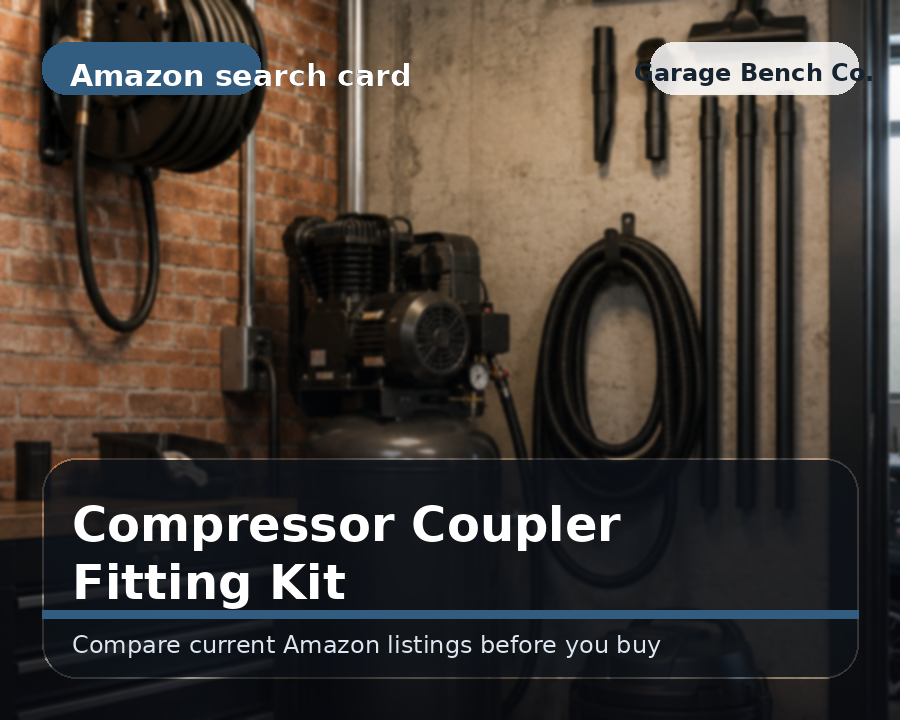
These are category-level Amazon search cards tied to the roles discussed here. They keep the affiliate section useful without pretending one exact listing is already the verified forever answer.
Disclosure: these are Amazon affiliate links. If you use one, Garage Bench Co. may earn a commission at no extra cost to you.
A broad search for standardizing a small garage compressor setup.
Useful if higher-demand pneumatic tools are part of the workflow.
A wider search lane when the current system is a compatibility mess.
Yes. Compatibility, leak resistance, and flow can noticeably affect how the system behaves.
Leaks are a common cause, along with fitting issues and general system inefficiency.
Not always. They matter more when higher-demand air tools are part of the setup.
Yes. A cleaner standardized system is easier to maintain and much less annoying.
They can be fine for light use, but poor seals and rough threads can make them false economy.