Spec that matters
CFM at working PSI:
the most important spec for whether air tools keep running.
Garage Bench Co.
Serious DIY garage workshop guidance
Comparison guide
Choose 30 gallons for occasional air tools and a more flexible garage footprint. Choose 60 gallons when you need a dedicated stationary compressor with more reserve and higher-CFM options.
Written by
Updated
August 18, 2026
Best use
Home garage users deciding between mid-size and stationary compressor setups.
Quick answer
Choose 30 gallons for occasional air tools and a more flexible garage footprint. Choose 60 gallons when you need a dedicated stationary compressor with more reserve and higher-CFM options.
Who this guide is for
Home garage users deciding between mid-size and stationary compressor setups.
The Garage Bench Co. angle
This is the practical fork between portable-ish garage air and dedicated shop air.
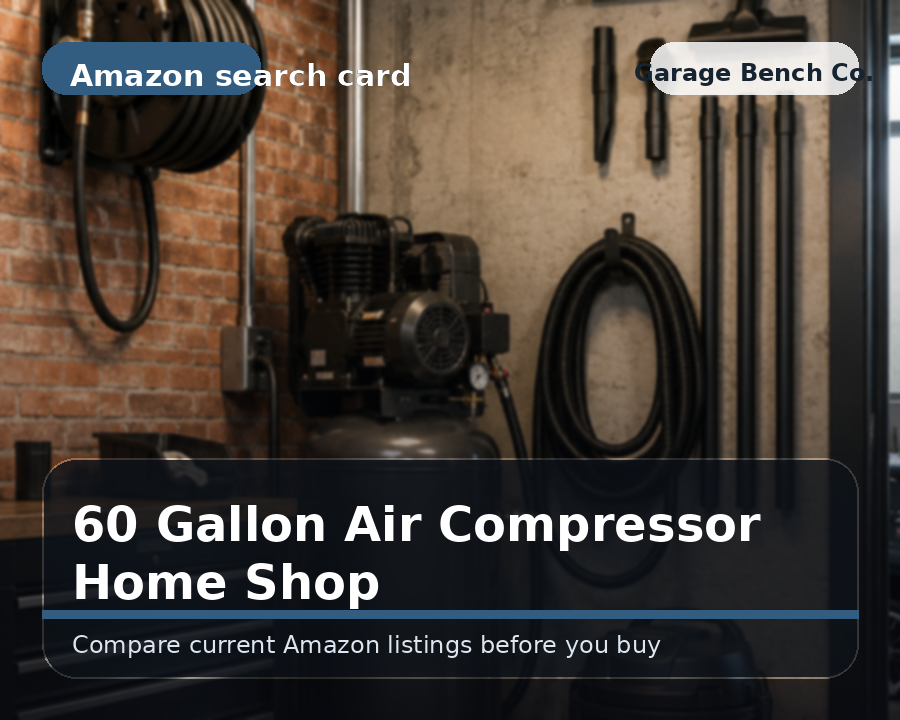
Air-system choices shape the whole garage
A 30-gallon compressor can work for occasional impact use, nailers, inflating, blow-off, and moderate garage tasks. It is easier to place and sometimes easier to power than a 60-gallon stationary unit.
A 30-gallon compressor can work for occasional impact use, nailers, inflating, blow-off, and moderate garage tasks. It is easier to place and sometimes easier to power than a 60-gallon stationary unit.
A 60-gallon compressor is better for repeated automotive work, higher-CFM tools, painting, grinding, and dedicated shop use. It is also more of an infrastructure decision.
A 60-gallon compressor with weak CFM can still disappoint. A 30-gallon compressor with good recovery can feel better than expected for intermittent tools. Check pump output.
Buy 30 gallons if the garage needs flexibility and air is occasional. Buy 60 gallons if air tools are a core part of the shop and the space/power setup is ready.
Compare equipment types in our topic overview. Then use the advice here for your specific decision.
Spec that matters
the most important spec for whether air tools keep running.
Spec that matters
helps with short bursts but does not replace pump output.
Spec that matters
must match the tool, but higher max PSI does not automatically mean better tool performance.
Spec that matters
decide whether the garage can safely power the compressor.
Spec that matters
matters in attached garages and neighborhoods.
Spec that matters
tells you how hard the compressor is meant to work.
Spec that matters
oil-free and oil-lubricated designs have different maintenance and use tradeoffs.
Spec that matters
critical for tools, tanks, hoses, and especially painting.
Spec that matters
can restrict airflow even when the compressor is strong enough.
Spec that matters
a compressor that is hard to drain or maintain will be neglected.
Mistake to avoid
Buying by tank gallons instead of CFM.
Mistake to avoid
Assuming high PSI means the compressor can run any tool.
Mistake to avoid
Buying a compressor for one air tool without comparing cordless.
Mistake to avoid
Ignoring hose diameter and fittings.
Mistake to avoid
Forgetting moisture control before painting.
Mistake to avoid
Underestimating compressor noise.
Mistake to avoid
Buying 240V equipment before checking the garage electrical setup.
Mistake to avoid
Skipping tank draining and basic maintenance.
Keep compressed air boring and safe
Product searches
These links open Amazon searches for the products or categories discussed here. Compare exact models, package contents, sellers, and current prices before buying.
Disclosure: these are Amazon affiliate links. If you use one, Garage Bench Co. may earn a commission at no extra cost to you.
The comparison search to use when you are deciding whether a real stationary compressor matches your garage wiring and long-term tool demand.
Useful when a bigger compressor only makes sense if the whole air-delivery layout becomes cleaner and easier to use.
A smart comparison search when moving up in compressor size also means taking moisture and pressure control more seriously.
It can be for occasional use if the CFM and hose setup match the tool.
Yes for frequent pneumatic work, painting, grinding, or dedicated shop use.
No. Tank size stores air; CFM output determines recovery.
Usually 30 gallons or smaller, unless the small garage is a dedicated shop.
This guide draws on the linked manufacturer documentation, official safety guidance, and primary technical references. Product details can change, so confirm current specifications and instructions with the manufacturer before buying or using equipment.
Read next
The hub ties sizing, compressors, hoses, moisture control, maintenance, pneumatic tools, and cordless alternatives back together.