Spec that matters
Mobility:
Does the system move, or does it stay in the garage?

Garage Bench Co.
Serious DIY garage workshop guidance
Setup guide
Organize cordless tools by frequency of use and platform: daily-use tools near the bench, batteries and chargers in a cool dry charging zone, accessories in labeled organizers, and mobile/project tools in modular boxes.
Written by
Garage Bench Co. Editorial Team
Updated
May 10, 2026
Best use
Cordless platform users who own drills, impacts, saws, lights, vacs, inflators, and batteries.
Quick answer
Organize cordless tools by frequency of use and platform: daily-use tools near the bench, batteries and chargers in a cool dry charging zone, accessories in labeled organizers, and mobile/project tools in modular boxes.
Who this guide is for
Cordless platform users who own drills, impacts, saws, lights, vacs, inflators, and batteries.
The Garage Bench Co. angle
Cordless tools need zones: tools, batteries, chargers, bits, accessories, and project kits.
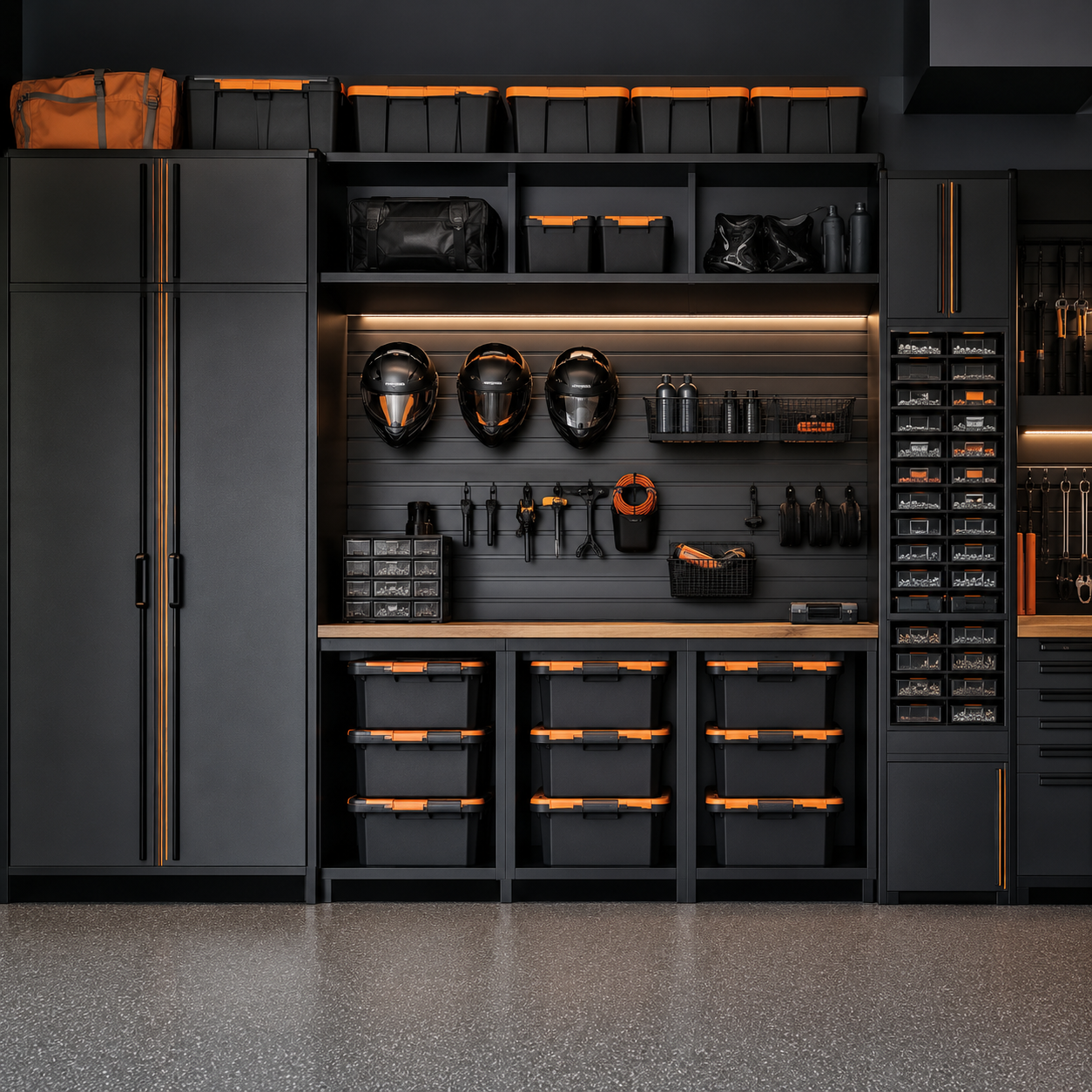
Storage decisions change daily workflow
Keep the most-used tools closest to the workbench: drill, impact, light, measuring tools, and bits. Less-used saws, grinders, and specialty tools can live on shelves, drawers, or modular boxes.
Keep the most-used tools closest to the workbench: drill, impact, light, measuring tools, and bits. Less-used saws, grinders, and specialty tools can live on shelves, drawers, or modular boxes.
Batteries and chargers need visibility and airflow. Bits, blades, sockets, adapters, and fasteners need labeled small-parts storage. Do not throw everything into one heroic disaster bin.
If you own more than one battery platform, group tools and chargers by platform. Add labels so you do not waste time hunting for the one charger that fits the one battery currently hiding behind a box of old drywall anchors.
Put tools that leave the garage into modular boxes or project kits. Keep stationary daily-use tools visible and easy to grab.
| Storage System | Best Fit | Biggest Strength | Watch-Out |
|---|---|---|---|
| Milwaukee PACKOUT | Serious DIYers, trades-adjacent users, mobile setups, premium garage systems | Deep ecosystem, strong compatibility, drawers, organizers, boxes, totes, wall/mounting options | Expensive and often overbuilt for purely stationary garage storage |
| DEWALT TOUGHSYSTEM 2.0 | DeWalt users, jobsite-to-garage users, large-tool storage | Rugged boxes, good mobile storage, DXL workstation direction | Accessory ecosystem and drawer/storage mix may not feel as deep as PACKOUT for some users |
| ToughBuilt StackTech | Users who like drawer access, self-locking stack design, newer ecosystem direction | Self-aligning/auto-locking interface, IP65 boxes/organizers, strong garage/workshop expansion vision | Newer ecosystem, availability and lineup maturity should be checked before buying heavily |
| RYOBI LINK | Homeowners, lighter-duty garage organization, wall storage, value-conscious DIYers | Wall rails, hooks, bins, homeowner-friendly organization, same LINK concept across mobile/wall pieces | Mobile box availability and retailer support should be verified before building the whole garage around it |
| Wall Rail / Slatwall Systems | Small garages, stationary tool zones, gardening/yard/tool walls | Gets tools off the floor and improves visibility | Not ideal for frequently transported tools |
| Tool Chest / Drawer Storage | Mechanics, sockets, hand tools, precision organization | Fast access and better small-tool sorting | Does not transport easily and can become a junk drawer fortress |
| Need | Better Choice | Why |
|---|---|---|
| Tools leave the garage often | Rolling modular storage | Stackable boxes and organizers move as one system |
| Tools stay in the garage | Wall storage + drawer storage | Faster access and less heavy stacking |
| Small garage with one parking spot | Wall rails, shallow cabinets, mobile bench, compact drawers | Keeps the floor clear and zones flexible |
| Many sockets/hand tools | Tool chest or drawer boxes | Drawers beat deep boxes for small hand tools |
| Many power tools/batteries | Open shelves, charging shelf, tool hangers, platform bins | Easier visibility and charging workflow |
| Fasteners/bits/small parts | Clear organizers or shallow drawer organizers | Small parts need separation and labels |
| Outdoor/yard tools | Wall rail system | Long handles and bulky items belong on walls |
| Jobsite-style transport | PACKOUT / TOUGHSYSTEM / StackTech | Rugged mobile systems make sense when tools travel |
Spec that matters
Does the system move, or does it stay in the garage?
Spec that matters
Can you reach tools without unstacking half the system?
Spec that matters
Deep boxes protect bulky tools but can hide small items.
Spec that matters
Drawers matter for sockets, bits, accessories, and frequent access.
Spec that matters
Wall rails and mounts can save more space than another rolling box.
Spec that matters
Wall systems, shelves, drawers, and rolling boxes all have limits.
Spec that matters
A system is only useful if the pieces you need are available.
Spec that matters
Cordless tools need batteries, chargers, and cord control planned into storage.
Mistake to avoid
Buying a heavy modular tower when tools never leave the garage.
Mistake to avoid
Hiding daily-use tools in deep boxes.
Mistake to avoid
Ignoring small-parts storage until every project turns into a scavenger hunt.
Mistake to avoid
Mounting wall storage without checking studs, fasteners, and load limits.
Mistake to avoid
Forgetting batteries and chargers when planning power tool storage.
Mistake to avoid
Buying into a storage system without checking current availability of future pieces.
Keep the storage system boring and safe
Safe affiliate shortlist
These are category-level Amazon search cards tied to the products and storage roles discussed here. They keep the affiliate section useful without pretending a single exact listing is already the one verified choice.
Disclosure: these are Amazon affiliate links. If you use one, Garage Bench Co. may earn a commission at no extra cost to you.

A clean PACKOUT search if you want to compare the drawer-heavy starter pieces people actually live with in a garage.
Useful when you want to compare a DeWalt-leaning modular setup without committing to one exact verified listing.
A strong homeowner-oriented search if your storage plan is more wall-first than rolling-stack-first.
Follow manufacturer guidance. Many users store batteries separately for visibility and charging control.
Near the bench in a cool, dry, visible area with cord management.
Group tools, batteries, and chargers by platform and label each zone.
Daily-use tools are often better on shelves or organizers; mobile tools belong in boxes.
Use labeled organizers or shallow drawers near the tools that use them.
This article was drafted from the Garage Bench Co. topical dominance plan and supported by official manufacturer pages, safety guidance, and buyer-pain research. Before publication, verify exact live product data, current pricing, retailer availability, affiliate URLs, and any model-specific capacities or compatibility claims.
Read next
The hub ties modular storage, wall organization, charging zones, small-parts storage, and garage workflow back together.