12V shines at
Compact size, easier handling, light-duty tasks, and tools you actually want to grab for quick jobs.

Garage Bench Co.
Serious DIY garage workshop guidance
Starter system decisions
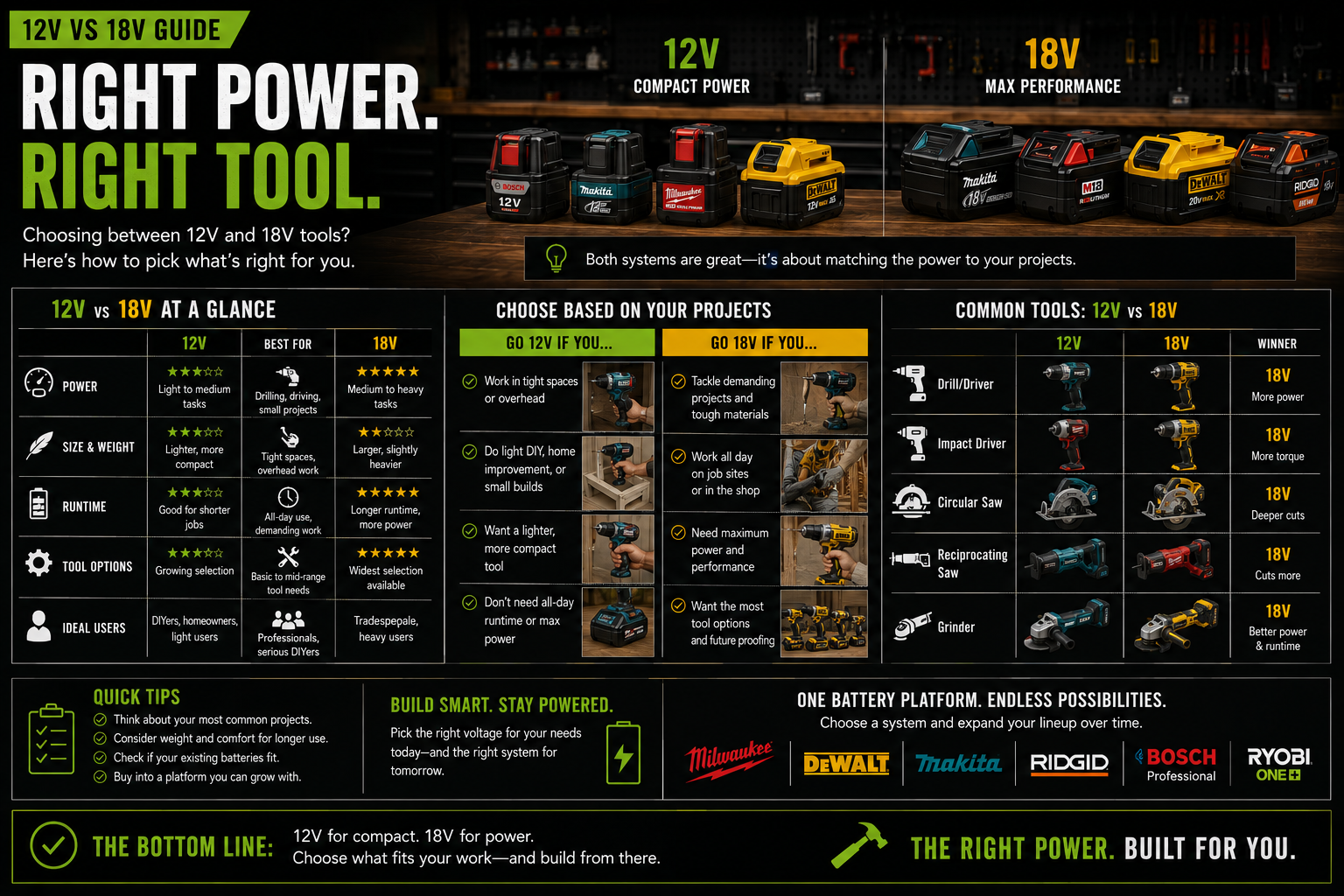
Voltage becomes confusing because buyers hear two bad simplifications at once. One says 12V is too weak to matter. The other says 18V is always the adult choice. Neither is very useful. Compact 12V tools can be excellent for lighter work, smaller hands, quick access, and comfort. But for most homeowners choosing a first main cordless system, 18V is still the safer long-term answer. The real decision is whether you are buying a compact helper system or the platform that will carry most of your home and garage projects.
Written by
Garage Bench Co. Editorial Team
Updated
May 9, 2026
How to use this guide
Use the shortlist and tradeoffs below to find the best fit for your garage, then check the linked methodology, affiliate disclosure, and next-step guides if you want the deeper why behind the recommendation.
Quick answer
Disclosure: some product mentions below are affiliate links. If you use one of them, Garage Bench Co. may earn a commission at no extra cost to you. The recommendations still stay focused on what makes the most sense for your garage, budget, and next step.
For most homeowners, 18V is the smarter first cordless system because it gives you more headroom, a broader tool lineup, and a better chance of avoiding an early platform reset. Something like a brushless 18V starter combo kit makes more sense as your main setup. 12V is not a toy, though. Compact kits like a 12V drill and impact combo kit can be great for light-duty work, apartment-style fixes, and homeowners who care a lot about size and comfort. The cleanest rule is this: start 18V when you want one main system, start 12V only when you already know the compact limits fit your life.
12V tools are great at keeping the tool light, compact, approachable, and comfortable. That matters more than some buyers expect. If the tool is smaller and easier to grab, you may actually use it more often for the quick jobs that make up a lot of normal homeowner life.
Compact drills, drivers, installation tools, lights, and small specialty tools can all make a lot of sense on 12V. This is especially true for people who do mostly assembly, hardware installs, pilot holes, lighter repairs, and tasks where control matters more than maximum power.
Compact size, easier handling, light-duty tasks, and tools you actually want to grab for quick jobs.
Broad coverage, better headroom, heavier project support, and more confidence as a main platform.
Are you buying a helper system, or the system that needs to cover almost everything?
18V wins for first-system buying because it gives homeowners more room to grow. Even if your current tasks are moderate, projects have a habit of getting bigger once you own the tools. The first shelf becomes garage storage. The first simple repair becomes a workbench. The first drill purchase turns into a platform decision.
That is why 18V is usually the safer recommendation. It does not mean everyone needs maximum power. It means the system is more likely to keep working as your projects get slightly more ambitious.
12V is excellent for apartment and condo owners, homeowners who mainly do light repairs, buyers with smaller hands, people who dislike bulky tools, and anyone who wants a compact secondary system for quick jobs. It is also strong for drawers, cabinet installs, hardware swaps, light pilot drilling, and repetitive tasks where size and comfort matter more than brute force.
The key is respecting the lane. 12V can be wonderful when you buy it for what it actually does well instead of pretending it is a universal substitute for a larger main system.
18V is better for a garage setup, a first cordless platform, repeated wood-and-metal projects, bigger holes, tougher fasteners, and the whole category of homeowner work where you want one system to cover most needs confidently. It is also the better lane once you start caring about outdoor tools, inflators, vacs, saws, lights, and all the other platform sprawl that follows tool ownership.
In other words, 18V is usually the right answer when the tool platform is supposed to support a real home and garage life instead of just quick indoor fixes.
A two-platform setup makes sense when 18V is your main system and 12V becomes your compact convenience layer. That can be a very rational arrangement for homeowners who use tools often, especially if they want the stronger main platform for garage work but still appreciate small 12V tools for indoor tasks and lighter repetitive jobs.
What does not make much sense is buying 12V first, then quickly realizing you also need 18V for the jobs that matter. That often turns the first purchase into an expensive detour.
Best buying instinct
Start 18V when you want one main homeowner system. Add 12V later when compact comfort becomes a real secondary advantage instead of an aspirational idea.
Amazon product cards
These cards point to specific Amazon listings that fit the products and roles discussed here, so you can compare exact options instead of broad search results.
Disclosure: these are Amazon affiliate links. If you use one, Garage Bench Co. may earn a commission at no extra cost to you.

A good lane for buyers who truly want compact convenience and understand the limits of making it a main system.

The better default for homeowners who want one platform to cover a broader range of home and garage work.

A very good example of where compact tools can feel genuinely smarter, not just smaller.

A broad search lane that makes the main-system logic obvious once you start thinking beyond the first drill and impact kit.

A useful example of how 12V often makes the most sense as a convenient secondary layer after the main system is already handled.
Often, yes, for lighter home tasks. The problem is not that 12V cannot work, it is that it may not be the best first main system for broader home and garage growth.
Not usually as a first main platform. It is often simply the safer long-term system, even when the early tasks are not especially demanding.
For most homeowners, 18V should be the first system. 12V usually makes more sense as a secondary compact layer or a very intentionally limited main system.
When you already have a stronger main system and want lighter, smaller tools for quick jobs, indoor tasks, or comfort-first repetitive work.
In practical homeowner terms, yes. Different brands label it differently, but it sits in the same general full-size cordless-tool class.
Read next
That is where the Ryobi versus DeWalt comparison becomes much clearer.