Must-have
Drill, impact driver, at least one usable battery pair, and a solid charger.
Garage Bench Co.
Serious DIY garage workshop guidance
Starter kits
Most homeowners do not need the biggest combo kit on the shelf. They need the right first kit, one that covers the work they will actually do, gives them a clean starting point for future purchases, and does not waste budget on filler tools they barely touch.
Written by
Garage Bench Co. Editorial Team
Updated
May 9, 2026
How to use this guide
Use the shortlist and tradeoffs below to find the best fit for your garage, then check the linked methodology, affiliate disclosure, and next-step guides if you want the deeper why behind the recommendation.
Quick answer
Disclosure: some product mentions below are affiliate links. If you use one of them, Garage Bench Co. may earn a commission at no extra cost to you. The recommendations still stay focused on what makes the most sense for your garage, budget, and next step.
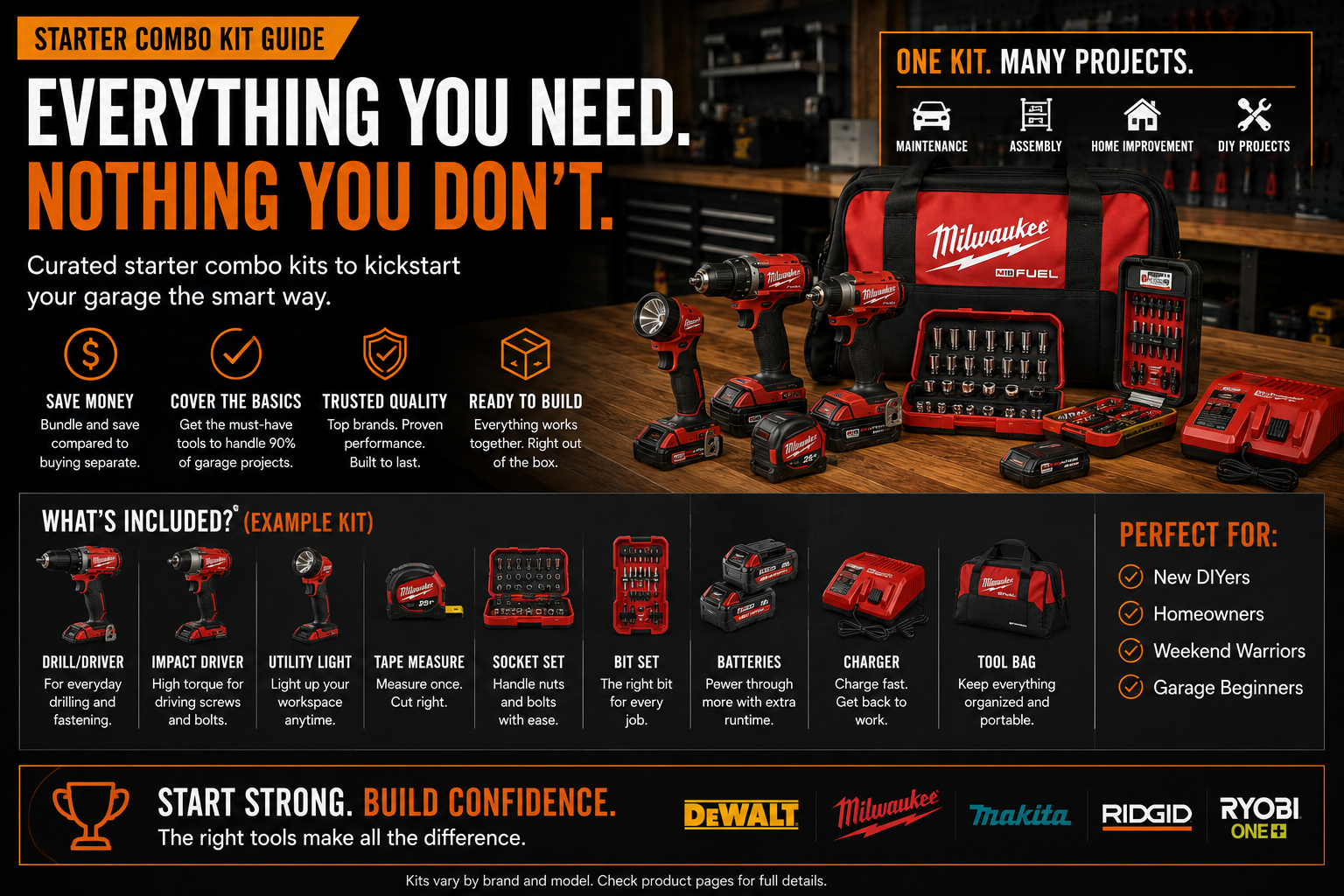
For most homeowners, the best starter combo kit is a 2-tool or 4-tool kit built around a drill, impact driver, and sensible battery package. If you want the best overall value and easy growth, the RYOBI ONE+ 18V Cordless 2-Tool Combo Kit (Renewed) is usually the smartest buy. If you want a stronger long-term step-up, the DEWALT 20V MAX Brushless 2-Tool Combo Kit (DCK277D2) is the better premium choice. In most cases, buying a bloated kit with too many mediocre tools is worse than buying a tighter kit and adding smarter tools later.
The best first kit for a homeowner is usually more modest than retail displays suggest. Most people need a drill, an impact driver, enough battery to avoid constant swapping, and a charger that does not feel frustrating. That simple setup covers an enormous amount of real-world work: hanging shelves, assembling storage, driving structural screws, putting together workbenches, minor repairs, garage organization, deck touch-ups, and general home maintenance.
Once you get beyond those basics, kit quality matters more than tool count. A well-picked 2-tool brushless kit is often a better starter purchase than a 6-tool bundle full of compromised tools you would never choose individually. Homeowners tend to get more value when they buy the core tools well and add specialized tools as real needs appear.
Drill, impact driver, at least one usable battery pair, and a solid charger.
Circular saw, oscillating tool, or work light, depending on your project mix.
Huge tool count when the included tools are weak or not useful for the buyer.
You want the least regrettable first buy, the strongest core tools, and a cleaner budget path for smarter additions later.
Your next projects are already ambitious enough that the extra tools are real needs, not box-count vanity.
Big kit counts with weak batteries, filler tools, or a charger you will resent six weeks later. Cheap bulk is not the same thing as value.
| Kit type | Best for | Main strength | Main watch-out | Best first move |
|---|---|---|---|---|
| 2-tool brushless kit | Most homeowners | Strongest quality-per-dollar foundation | May feel too modest only if you mistake tool count for value | Buy this first unless you already know you need more |
| Ryobi value kit | Budget-conscious first-platform buyers | Easy entry cost with broad future expansion | Less premium upside if your use gets heavy fast | Choose it when sensible ownership cost matters most |
| DeWalt premium starter kit | Heavier DIY homeowners | Stronger long-term step-up with better premium confidence | Often more spend than moderate-use buyers need | Buy in when repeat project volume is already obvious |
| Focused 4-tool kit | Readers with immediate bigger projects | Can be efficient when the extra tools are genuinely useful | Easy place for filler and weak battery bundles to sneak in | Only choose this when you can name the next projects already |
Best overall for most homeowners
If you are trying to make one smart first purchase, a quality 2-tool kit is the most reliable answer. It gives you the two tools you will use the most, usually includes a cleaner battery package, and leaves room in the budget for smarter future additions. Good examples are the RYOBI ONE+ 18V Cordless 2-Tool Combo Kit (Renewed) and the DEWALT 20V MAX Brushless 2-Tool Combo Kit (DCK277D2).
Best value pick
Ryobi remains the best value entry lane for many homeowners because the kits are often easier to afford and the platform makes it easy to keep adding tools later without a huge cost jump. That makes it one of the most forgiving starting points. The RYOBI ONE+ 18V Cordless 2-Tool Combo Kit (Renewed) is the cleanest example of that value-first lane.
Best premium homeowner starter
If you already know you want a stronger platform and better long-term tool quality, a DeWalt brushless starter kit is often the best premium homeowner path. It costs more, but it tends to make more sense than buying a cheaper kit and planning to replace it. The DEWALT 20V MAX Brushless 2-Tool Combo Kit (DCK277D2) is the most sensible version of that move.
Best if you want more than 2 tools
If your garage plans already include storage builds, shelves, and repeat projects, a well-chosen 4-tool kit can make sense. The key is that the added tools need to be real tools you were likely to buy anyway, not filler added to make the box look bigger. The DEWALT 20V MAX XR Cordless Drill Combo Kit, 4-Tool (DCK494P2) is the kind of focused bigger-kit buy I mean.
Two tools is enough for most homeowners to start well. Four tools can be smart if you already know the next project wave is coming. Six or more only makes sense when the kit is unusually well-built and you genuinely need most of what is inside.
The biggest trap in this category is confusing volume with value. A cheap multi-tool kit can look like a bargain while quietly giving you smaller batteries, weaker tools, and pieces you would never have bought individually. That usually creates a worse ownership experience than a tighter, stronger starter setup.
If you are unsure, buy the better 2-tool kit. It is the safest answer. The next smart additions are usually a circular saw, oscillating multi-tool, inflator, compact shop blower, or task light, depending on what kind of home and garage work you actually do.
Best buying instinct
Prioritize battery quality, drill quality, and impact-driver usefulness over raw tool count. A combo kit is a foundation purchase, not a race to collect the most plastic.
Amazon product cards
These cards point to specific Amazon listings that fit the products and roles discussed here, so you can compare exact options instead of broad search results.
Disclosure: these are Amazon affiliate links. If you use one, Garage Bench Co. may earn a commission at no extra cost to you.

A practical first purchase if you want a capable drill and impact-driver pair, decent batteries, and an affordable path into the rest of the ONE+ lineup.

A better buy than the usual cheap box-store specials if you want stronger core tools from the start and expect to keep building the system over time.

Worth the extra spend if you care about better feel in the hand, smoother ownership, and a starter kit you are less likely to outgrow quickly.

A smarter bigger-kit option if your next few projects are already obvious and you would rather buy once than piece the first wave together tool by tool.
Yes. A drill and impact driver cover far more real homeowner work than most people expect. It is a strong, flexible starting point.
A 4-tool kit makes sense when you already know you will use the additional tools soon, especially for storage builds, garage upgrades, or repeat DIY projects.
Often yes, especially if the price gap is reasonable and you expect regular use. Brushless usually makes more sense in a core drill and impact driver than in every tool you will ever buy.
Usually either a circular saw, oscillating tool, inflator, compact shop blower, or task light. The right next move depends on your actual project list.
Read next
If you have not settled on the battery ecosystem yet, compare the homeowner platform guide before you buy. That usually saves more regret than any sale price does.