Buy for your next 5 tools, not your first 2
Most platform regret happens when buyers focus only on the starter drill and driver.
Garage Bench Co.
Serious DIY garage workshop guidance
Cordless platforms
If you are a homeowner choosing one cordless system for garage projects, home maintenance, and future upgrades, the smartest move is usually not the most expensive platform. It is the one that covers the tools you will really buy, keeps battery costs reasonable, and lets you grow without starting over six months later.
Written by
Garage Bench Co. Editorial Team
Updated
May 9, 2026
How to use this guide
Use the shortlist and tradeoffs below to find the best fit for your garage, then check the linked methodology, affiliate disclosure, and next-step guides if you want the deeper why behind the recommendation.
Quick answer
Disclosure: some product mentions below are affiliate links. If you use one of them, Garage Bench Co. may earn a commission at no extra cost to you. The recommendations still stay focused on what makes the most sense for your garage, budget, and next step.
For most homeowners, Ryobi 18V ONE+ is the best cordless tool platform because it gives you broad tool coverage, easier entry pricing, and enough capability for the overwhelming majority of home and garage tasks. A smart place to start is the RYOBI ONE+ 18V Cordless 2-Tool Combo Kit (Renewed). If you are a heavier DIY user who expects to upgrade into stronger tools and build a more serious garage setup, DeWalt 20V Max XR is usually the best step-up choice, with the DEWALT 20V MAX XR Hammer Drill and Impact Driver Kit (DCK250QQ2) being a strong entry point. If you want the deepest premium ecosystem and do not mind paying more, Milwaukee M18 has the highest long-term ceiling, and the Milwaukee 2997-22 Hammer Drill and Impact Driver Kit is the premium path I would start with.
A cordless platform is not just a drill decision. It is a battery decision, a charger decision, a future-tool decision, and often a storage decision too. That is why people regret this category so often. They buy one attractive kit, then realize the rest of the lineup does not fit how they actually use their garage.
For most homeowners, the right question is not “which brand is best?” It is “which platform makes the most sense for the kind of projects I really do?” If you mostly hang shelves, build simple storage, maintain a house, assemble furniture, tackle weekend repairs, and occasionally step into bigger garage projects, you do not need to buy like a framing crew. You need a platform with strong everyday coverage, reasonable battery cost, and enough room to grow.
That usually comes down to five things: lineup breadth, starter cost, battery value, ease of finding replacement tools locally, and whether the platform feels like it fits a homeowner life rather than a jobsite identity.
Most platform regret happens when buyers focus only on the starter drill and driver.
A platform with cheap entry tools but painful battery pricing can get expensive fast.
Easy replacements and sale pricing make ownership simpler over time.
You want one affordable system for normal home ownership, garage organization, common repairs, and steady add-on tool growth without premium-brand pricing.
You already know your projects will be heavier, more frequent, or more serious than casual homeowner use, and you want a stronger long-term step-up path.
Buying by internet brand mythology instead of by your next real five tool purchases. That is how homeowners end up paying for platform ceiling they never use.
| Platform | Best for | Main strength | Main watch-out | Best first move |
|---|---|---|---|---|
| Ryobi 18V ONE+ | Most homeowners | Broad tool coverage and easier ownership cost | Less compelling if you already know you want a more premium garage path | Start with a solid brushless 2-tool kit |
| DeWalt 20V Max XR | Heavier DIY homeowners | Stronger premium balance of performance, availability, and future depth | Usually more money than moderate users need | Buy in when repeated projects are already part of the plan |
| Milwaukee M18 | Premium-first garage builders | Deep specialty ecosystem and strong long-term ceiling | Easy to overbuy for normal household use | Choose it when specialty and mechanic crossover really matter |
| Ridgid 18V | Value-minded step-up buyers | Useful middle lane between entry-value and premium pricing | Less universal ecosystem mindshare than the biggest brands | Consider it when Ryobi feels too light and DeWalt feels too expensive |
Best for most homeowners
Ryobi is the easiest recommendation for most homeowners because the system covers an enormous range of home and garage tools, the entry price is usually friendlier, and it is easier to build momentum without feeling punished every time you add a new tool. A strong example is the RYOBI ONE+ 18V Cordless 2-Tool Combo Kit (Renewed).
Best step-up platform
DeWalt makes the most sense for homeowners who know they are going to do more than light weekend tasks and want a cleaner path into stronger brushless tools, better jobsite crossover, and a longer-term garage workshop setup. The DEWALT 20V MAX XR Hammer Drill and Impact Driver Kit (DCK250QQ2) is a clean way to buy into that path.
Best premium ceiling
Milwaukee M18 is a serious long-term platform with deep specialty-tool depth and a reputation that appeals to buyers who want the biggest ceiling. It is a strong system, but many homeowners will pay more for capability they may not need right away. If you know you want that premium lane, the Milwaukee 2997-22 Hammer Drill and Impact Driver Kit is the kind of starter buy that fits it.
Best if you want durable value
Ridgid sits in a useful middle lane for homeowners who want stronger value than a premium system but do not want to feel like they bought an obviously entry-level path. It is not the most exciting platform, but it can be a smart practical one. The RIDGID 18V SubCompact Brushless 2-Tool Combo Kit is a good example of that middle-ground buy.
Homeowners get pushed toward identity-driven buying in this category. A lot of platform advice is basically social signaling dressed up as expertise. That is not helpful when you are trying to build a garage that works better without burning money.
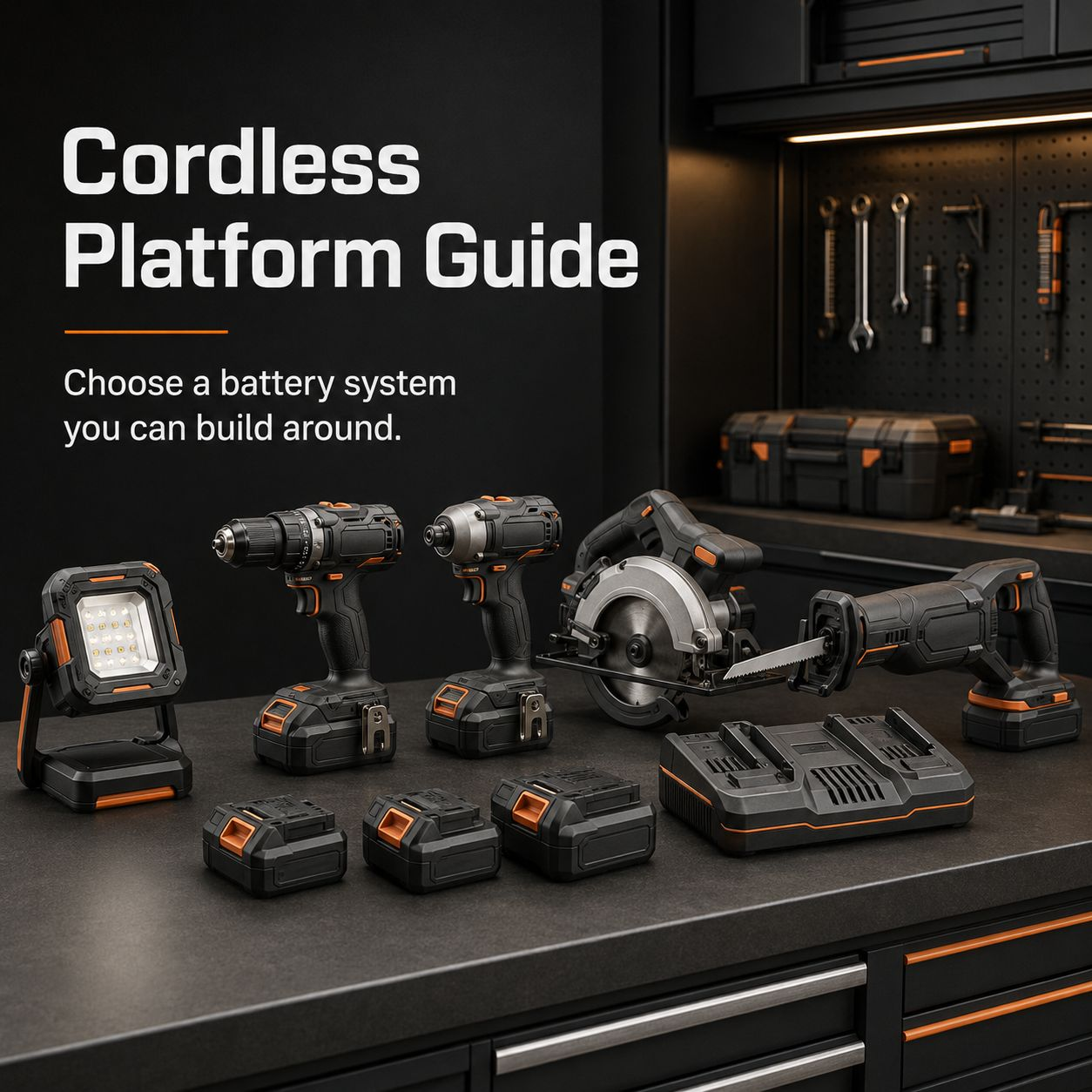
The most important factor is usually tool coverage. Can the platform handle your likely next purchases, like a circular saw, oscillating tool, impact driver, inflator, shop blower, work light, and compact vacuum? If yes, you are in a good place. If no, the platform will start feeling limited almost immediately.
After that, battery economics matters more than many reviews admit. Batteries are what turn a first tool into a system. A platform that feels affordable on day one can become annoying if every battery expansion feels overpriced. Homeowners do best when they can add tools and batteries steadily instead of making one expensive leap.
Finally, think about where your garage is heading. If you already know you are building workbenches, storage walls, mechanic capability, and regular project volume, stepping into DeWalt or Milwaukee sooner can make sense. If you are still in the “I want one system that covers almost everything around the house and garage” phase, Ryobi remains very hard to beat.
Simple rule
If you are not sure whether you are a casual homeowner or a serious DIY buyer yet, buy the platform that makes it easy to keep building. For most people, that means strong value and broad tool coverage first, then selective upgrades later.
Amazon product cards
These cards point to specific Amazon listings that fit the products and roles discussed here, so you can compare exact options instead of broad search results.
Disclosure: these are Amazon affiliate links. If you use one, Garage Bench Co. may earn a commission at no extra cost to you.

A strong first buy if you want solid drill and impact-driver performance, a broad homeowner-friendly ecosystem, and an easier path into future garage add-ons.

The right kind of jump if you already know you want a stronger garage path, better batteries, and a more premium platform without going straight into the deepest-price lane.

The premium choice if you already know you want to grow into M18 long term and are comfortable paying more now for the higher-end expansion path later.

A sensible pick if you want something more serious-feeling than entry kits without paying full premium-brand pricing right out of the gate.
Yes. For most homeowners, Ryobi is more than enough. It covers common repairs, light to moderate DIY work, garage upgrades, outdoor crossover, and a very wide tool catalog.
DeWalt is worth the jump when you are doing frequent projects, want stronger brushless tools, or care more about long-term serious DIY depth than lowest entry cost.
Yes, if you already know you are building a higher-end setup, especially if mechanic or specialty-tool expansion matters to you. It is just not the most cost-efficient answer for everyone.
Usually yes at first. Start with one platform and learn what gaps actually matter before you consider a second battery system.
Read next
If you are a homeowner trying to make one strong first purchase, the next step is choosing a starter combo kit that gives you enough capability without wasting budget.