Best use
Light masonry drilling like anchors in brick, block, or concrete.
Garage Bench Co.
Serious DIY garage workshop guidance
Cordless drill choices
The hammer drill upgrade confuses homeowners because it sounds more important than it often is. A hammer drill is basically a drill driver with an added hammering action for masonry. If you rarely drill brick, block, or concrete, that feature may barely matter. If the price gap is small, it is often a nice upgrade. If masonry is a real part of your project life, it becomes more useful. The trick is buying it for the right reason instead of treating it like automatic status.
Written by
Garage Bench Co. Editorial Team
Updated
May 9, 2026
How to use this guide
Use the shortlist and tradeoffs below to find the best fit for your garage, then check the linked methodology, affiliate disclosure, and next-step guides if you want the deeper why behind the recommendation.
Quick answer
Disclosure: some product mentions below are affiliate links. If you use one of them, Garage Bench Co. may earn a commission at no extra cost to you. The recommendations still stay focused on what makes the most sense for your garage, budget, and next step.
For many homeowners, a normal drill driver is enough. But if the hammer-drill version only costs a little more, buying the hammer model is often the smarter long-term move. A tool like the DEWALT DCD805 hammer drill gives you the extra masonry option without changing the day-to-day use very much. If you know you will almost never touch masonry, a normal drill driver like the DEWALT DCD800 is perfectly reasonable. And if the masonry job gets serious, a rotary hammer is often the more correct tool anyway.
A hammer drill adds a rapid forward-and-back tapping action while the bit spins. That hammering helps the bit chip into masonry more effectively than a normal drill driver can on its own. It is useful for lighter masonry jobs like anchors in brick, block, or concrete.
Outside of masonry, that extra mode changes almost nothing you care about. In normal wood, metal, and household drilling, you just use the tool like a regular drill. That is why the decision so often comes down to whether the small extra cost is worth having the capability in reserve.
Light masonry drilling like anchors in brick, block, or concrete.
It still behaves like a regular drill driver for wood, metal, and everyday tasks.
It helps, but it does not turn a homeowner drill into a serious demolition or rotary-hammer tool.
The hammer version is worth it when the price gap is modest, when you expect to install masonry anchors sometimes, or when you just want the more capable version of a tool you plan to keep for a while. This is especially true if you are already shopping in the better brushless tier, where the size and weight difference is often not dramatic.
For many homeowners, the hammer drill is not essential, but it is a nice low-regret upgrade when the cost penalty is small. That is a very different recommendation from saying everyone needs one.
A normal drill driver is enough when your work is mostly wood, metal, household assembly, pilot holes, storage installs, and normal repair work. That covers a huge amount of real homeowner use. If masonry almost never shows up, paying more just to feel safer about a hypothetical future job is not always the best move.
This is especially true for buyers trying to stay disciplined with starter-kit budgets. Better core tool quality often matters more than chasing every extra feature at once.
A hammer drill is helpful for lighter masonry work. It is not the same thing as a rotary hammer. If the job involves larger holes, repeated concrete drilling, or tougher material, a rotary hammer is usually the right tool and often faster, cleaner, and less frustrating.
This matters because some people overbuy the hammer drill expecting it to cover any masonry situation. It does not. It extends the normal drill's range a bit, which is useful, but it is still a homeowner-grade compromise compared with the purpose-built masonry tools.
The most common homeowner masonry jobs are not huge. They are things like fastening shelving to block, mounting a hose reel to brick, adding anchors to a foundation wall, or drilling occasional holes for a garage accessory. Those are exactly the jobs where the hammer mode is nice to have.
If that list sounds familiar, the hammer version starts to make more sense. If it does not, a normal drill driver is probably fine.
Best buying instinct
Buy the hammer version when the price jump is modest or you know masonry shows up sometimes. Skip it when the budget is tight and the project list is almost entirely wood-and-metal homeowner work.
Amazon product cards
These cards point to specific Amazon listings that fit the products and roles discussed here, so you can compare exact options instead of broad search results.
Disclosure: these are Amazon affiliate links. If you use one, Garage Bench Co. may earn a commission at no extra cost to you.
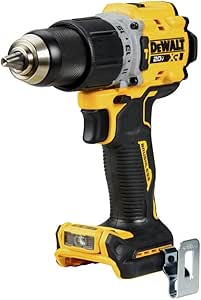
A good example of the kind of hammer-drill upgrade that makes sense when you want the extra mode without changing the whole ownership feel.

A strong normal-drill answer for buyers who do not expect masonry to be part of regular homeowner life.

Useful if you want the added masonry capability but are still buying with tighter starter-budget logic.

The right masonry bits matter a lot more once the hammer mode actually gets used.

The smarter answer once concrete work becomes substantial enough that a homeowner drill is no longer the right tool.
Sometimes. It is worth it when the price gap is modest or when occasional masonry jobs are realistic. It is not mandatory for every homeowner.
Yes. In normal drill mode, it behaves like a regular drill driver for wood, metal, and everyday use.
It helps a lot for lighter anchor work in brick, block, and concrete. That is one of the clearest homeowner use cases for the upgrade.
When the job involves repeated concrete drilling, larger holes, or more serious masonry work than a normal homeowner drill should really handle.
Read next
That usually means the combo-kit decision, the platform choice, and the phased buying order for the rest of the garage workshop.