Drill
Better for holes, lighter screw-driving, general household fixes, and one-tool flexibility.
Garage Bench Co.
Serious DIY garage workshop guidance
Core tool basics
Homeowners get confused by this pair because both tools look similar until you actually use them. A drill is the more universal first tool because it drills holes and handles normal screw-driving well. An impact driver is the tool that makes tougher fastening jobs easier, faster, and less frustrating. The right answer for most people is not choosing a winner in theory, it is understanding which tool solves the next year of real projects better.
Written by
Garage Bench Co. Editorial Team
Updated
May 9, 2026
How to use this guide
Use the shortlist and tradeoffs below to find the best fit for your garage, then check the linked methodology, affiliate disclosure, and next-step guides if you want the deeper why behind the recommendation.
Quick answer
Disclosure: some product mentions below are affiliate links. If you use one of them, Garage Bench Co. may earn a commission at no extra cost to you. The recommendations still stay focused on what makes the most sense for your garage, budget, and next step.
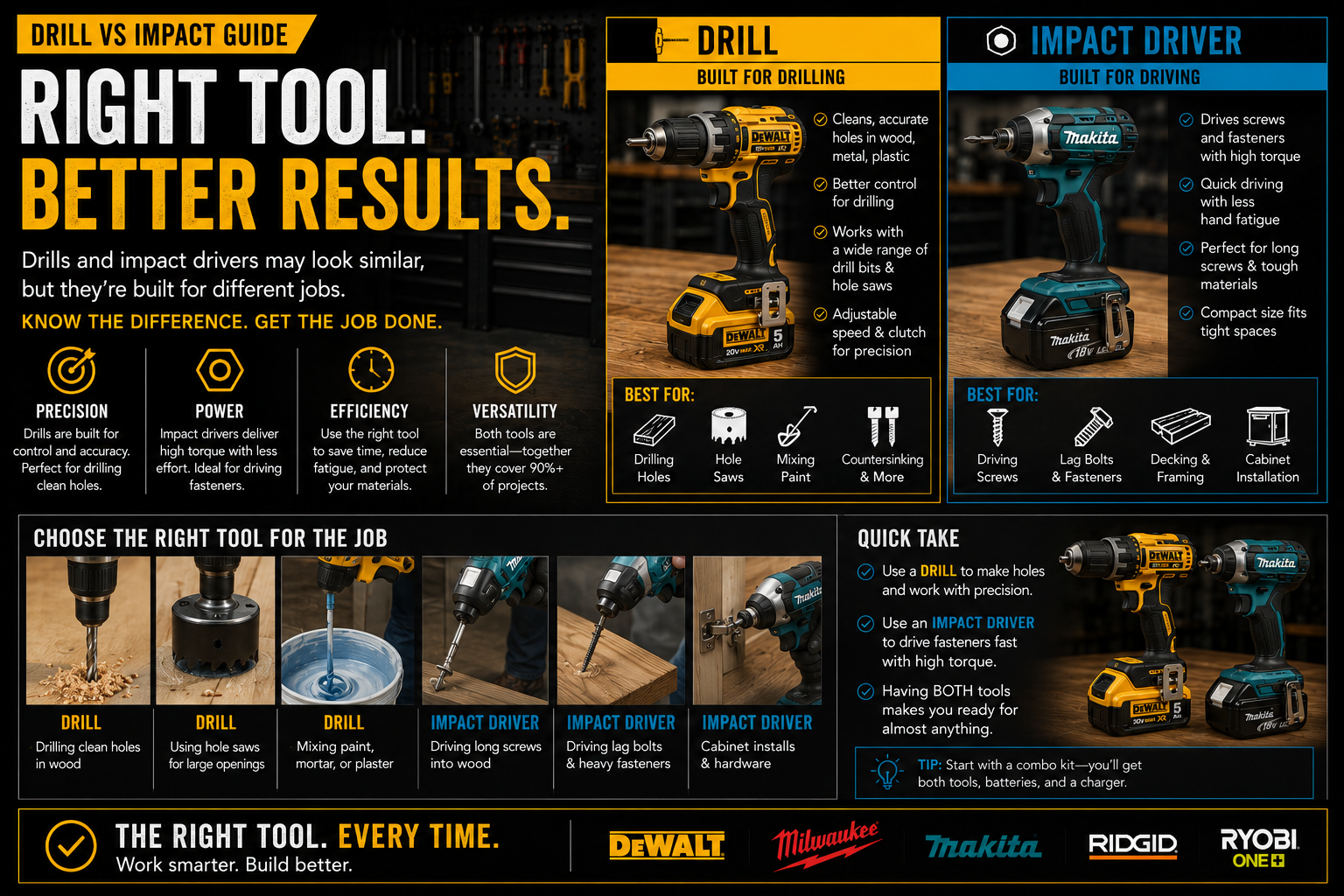
If you can only buy one tool first, buy a drill. It is more flexible for normal homeowner use because it drills holes, drives screws, and covers a wider range of small-to-medium jobs. But if you are buying a starter kit, a drill and impact-driver combo like the RYOBI ONE+ 18V Cordless 2-Tool Combo Kit (Renewed) or the DEWALT 20V MAX Brushless 2-Tool Combo Kit (DCK277D2) is usually the smartest move. A drill handles the everyday basics. An impact driver makes longer screws, repetitive fastening, and tougher material much easier.
A drill is the better all-arounder. It is the tool you want for drilling clean holes, running smaller screws, assembling furniture, installing shelves, and doing the kind of normal homeowner work that mixes boring holes with moderate fastening.
An impact driver is the fastening specialist. It shines when screws get longer, materials get tougher, and repetitive driving starts to make a normal drill feel strained or annoying. It is especially useful for structural screws, deck repair, outdoor projects, and any job where cam-out and wrist twist become part of the experience.
Better for holes, lighter screw-driving, general household fixes, and one-tool flexibility.
Better for tougher fasteners, longer screws, repetitive work, and jobs that push back harder.
One tool drills, the other drives, which is why the pairing works so well in real projects.
For most beginners, the answer is still the drill. It covers more of the basic homeowner job list and keeps the first purchase simple. If you are hanging blinds, putting together shelving, drilling pilot holes, mounting hooks, or doing basic repairs, the drill is the more useful solo tool.
The impact driver becomes the smarter first buy only when your immediate project list is unusually fastener-heavy, like deck repair, shed building, large shelving builds, or lots of structural screw work. That is not the average homeowner starting point.
A drill is enough when the screws are smaller, the materials are not especially demanding, and the job needs both holes and fasteners. That includes cabinet hardware, wall anchors, pilot holes, simple household assembly, and most beginner garage organization projects.
For a lot of homeowners, a good drill handles the first phase of ownership just fine. The problem is not that the drill is weak. The problem is expecting it to do heavy fastening work all day without making the job slower or more frustrating.
The impact driver starts making obvious sense when screws get long, dense materials get involved, or the job includes lots of repeated fastening. This is where deck boards, ledger screws, outdoor framing, beefier garage shelving, and repeated lag or structural screws enter the picture.
It also helps reduce bit slipping and wrist twist during tougher driving. That is the part many first-time buyers do not understand until they use one. The impact driver does not just add power, it makes harder fastening feel more controlled.
You want both when projects involve drilling and fastening in the same workflow. That is why combo kits are so useful. One tool stays loaded with a drill bit, the other stays loaded with a driver bit, and you stop wasting time swapping back and forth.
For most garage setups, this is the cleanest starting point. It is more efficient, more flexible, and one of the few combo-tool pairings that earns its place immediately.
Best buying instinct
If you are buying one tool, buy the drill. If you are buying a starter system, buy the combo kit and let each tool do the job it is best at.
Amazon product cards
These cards point to specific Amazon listings that fit the products and roles discussed here, so you can compare exact options instead of broad search results.
Disclosure: these are Amazon affiliate links. If you use one, Garage Bench Co. may earn a commission at no extra cost to you.

A practical first system buy if you want both tools without overspending and still want room to grow.

A stronger long-term combo choice if you already know the tools will get regular homeowner and garage use.

The cleanest one-tool start for homeowners who are not ready to buy a full combo kit yet.

Best reserved for homeowners whose next projects are unusually fastening-heavy right away.

A better bit set often improves the real experience more than buyers expect, especially once the impact driver enters the mix.
Sometimes for lighter work, yes. But once screws get longer or the fastening gets more repetitive, the impact driver becomes much more pleasant to use.
It can in some situations with the right hex-shank bits, but it is not the best general replacement for a drill driver.
If it is one tool, buy the drill. If it is a starter system, buy the combo kit and get both roles covered properly.
Because the pairing makes real project flow better. One tool drills, the other drives, and you stop swapping bits constantly.
Read next
That decision matters a lot less often, but it still matters enough to buy correctly when masonry shows up in the project list.