Mistake to avoid
Buying by brand loyalty before use case.
The best platform is the one that fits your actual projects, not the one with the loudest aisle display.

Garage Bench Co.
Serious DIY garage workshop guidance
Cordless platforms
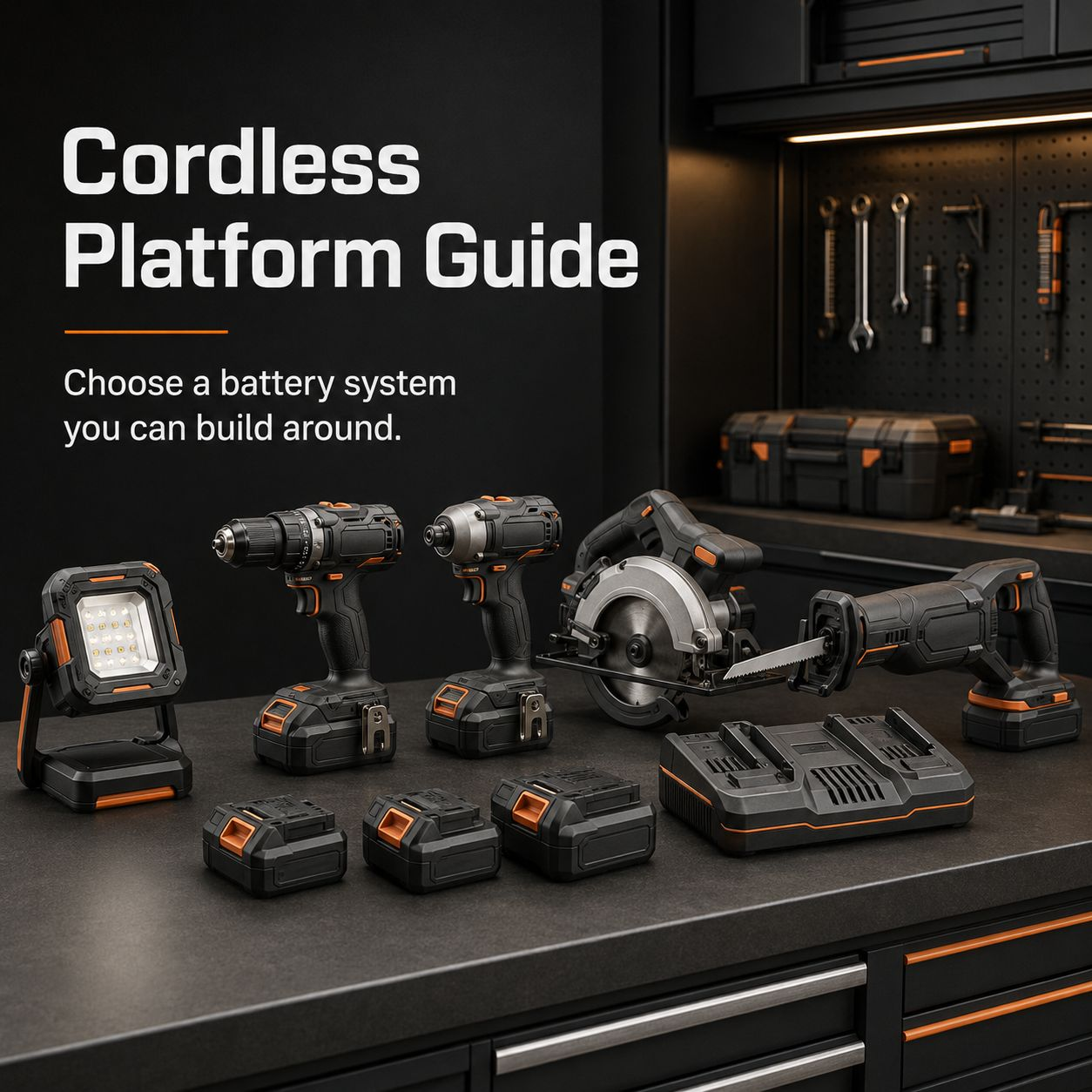
For a garage workshop, choose the platform that gives you the best whole-shop workflow: core tools, lights, vacs, inflators, specialty tools, batteries, chargers, and storage. Milwaukee is the strongest premium system, DeWalt is the best broad prosumer system, and Ryobi is the best budget whole-garage system.
Written by
Garage Bench Co. Editorial Team
Who this guide helps
Readers building a garage workshop rather than buying one isolated tool.
How to use this guide
Use the quick answer, tradeoffs, related guides, and product-shortlist placeholders to make a garage-fit decision without overbuying.
Quick answer
Disclosure: some product mentions and Amazon search cards below are affiliate links. If you use one, Garage Bench Co. may earn a commission at no extra cost to you.
For a garage workshop, choose the platform that gives you the best whole-shop workflow: core tools, lights, vacs, inflators, specialty tools, batteries, chargers, and storage. Milwaukee is the strongest premium system, DeWalt is the best broad prosumer system, and Ryobi is the best budget whole-garage system.
A garage platform has to cover drilling, fastening, lighting, vacs, fans, inflators, saws, mechanic tools, and storage—not just one drill.
A garage platform needs to support projects before, during, and after the cut or fastener. That means work lights, vacs, inflators, fans, small cleanup tools, charging zones, and wall or modular storage matter more than a pure torque spec.
DeWalt 20V MAX is the practical middle path for a lot of home-garage users. It has strong core tools, broad retail availability, and a clear path into higher-output batteries and FLEXVOLT tools for heavier applications.
Ryobi is excellent when the goal is to fill the garage with useful tools—lights, inflators, vacs, nailers, yard tools, and occasional-use project tools—without paying premium prices for every category.
| Platform | Best Fit | Biggest Strength | Watch-Out |
|---|---|---|---|
| Ryobi 18V ONE+ | Homeowners, casual DIYers, budget-conscious garage users | Huge range of affordable home, yard, cleanup, and project tools | Not the best choice for heavy daily pro use or the most demanding specialty tools |
| DeWalt 20V MAX | Homeowners who want a tougher prosumer platform | Strong mainstream pro/prosumer coverage, broad availability, strong drill/driver/saw ecosystem | Can cost more than homeowner-only platforms; 20V MAX is 18V nominal |
| Milwaukee M18 | Serious DIYers, home mechanics, users who want premium breadth | Deep pro platform, strong specialty tools, excellent overlap with PACKOUT and M12 | Often more expensive than homeowners need for occasional projects |
| Milwaukee M12 | Compact work, mechanic tasks, tight-space tools, second-platform strategy | Best-in-class subcompact ecosystem for ratchets, compact impacts, lights, installation tools | Not a full replacement for 18V/20V tools for saws, high-demand drilling, and bigger outdoor tools |
| Makita LXT | Woodworking-leaning DIYers and users who value ergonomics | Mature 18V slide-battery system with broad tool coverage | Less dominant at some U.S. retailers than Milwaukee/DeWalt/Ryobi; check local availability |
| Makita XGT | High-demand tools, larger saws, OPE, users stepping beyond 18V | Higher-power 40V/80V max system for heavy-load applications | Usually overkill as a first homeowner platform |
A good garage platform covers core tools plus lights, vacuums, inflators, chargers, storage compatibility, and future upgrade paths.
Yes, especially for homeowners and value-focused DIYers. Upgrade selectively for high-demand tools if needed.
It is arguably the strongest premium garage ecosystem, especially when combining M18 and M12.
DeWalt is better for heavier, more frequent use. Ryobi is often better for affordable breadth.
This article was drafted from the Garage Bench Co. topical dominance plan and supported by official platform pages, safety guidance, and competitor/pain-point research. Before publication, verify live product cards, pricing, model numbers, current availability, affiliate URLs, and any exact product specification claims.