Value-first lane
Ryobi usually wins when breadth and price matter most.
Good for homeowners who want a real platform without paying premium-brand tax on every future add-on.
Garage Bench Co.
Serious DIY garage workshop guidance
Cluster hub
A cordless platform is not just a drill purchase. It is a long-term system decision that affects your batteries, chargers, storage, lights, cleanup tools, outdoor tools, and future upgrade path.
Written by
Garage Bench Co. Editorial Team
Updated
May 10, 2026
How to use this guide
Use this hub to choose the right battery ecosystem first, then open the matching buyer-fit guides and brand comparisons.
Quick answer
The platform should match the work you expect to do over the next three to five years, not just the project sitting in front of you this weekend.
Who this guide is for
Readers who need the big-picture map before comparing specific brands, kits, battery sizes, or second-platform ideas.
The Garage Bench Co. angle
This hub keeps the decision framed around garage workflow, upgrade path, and real buyer fit, not brand-fan scoreboard noise.
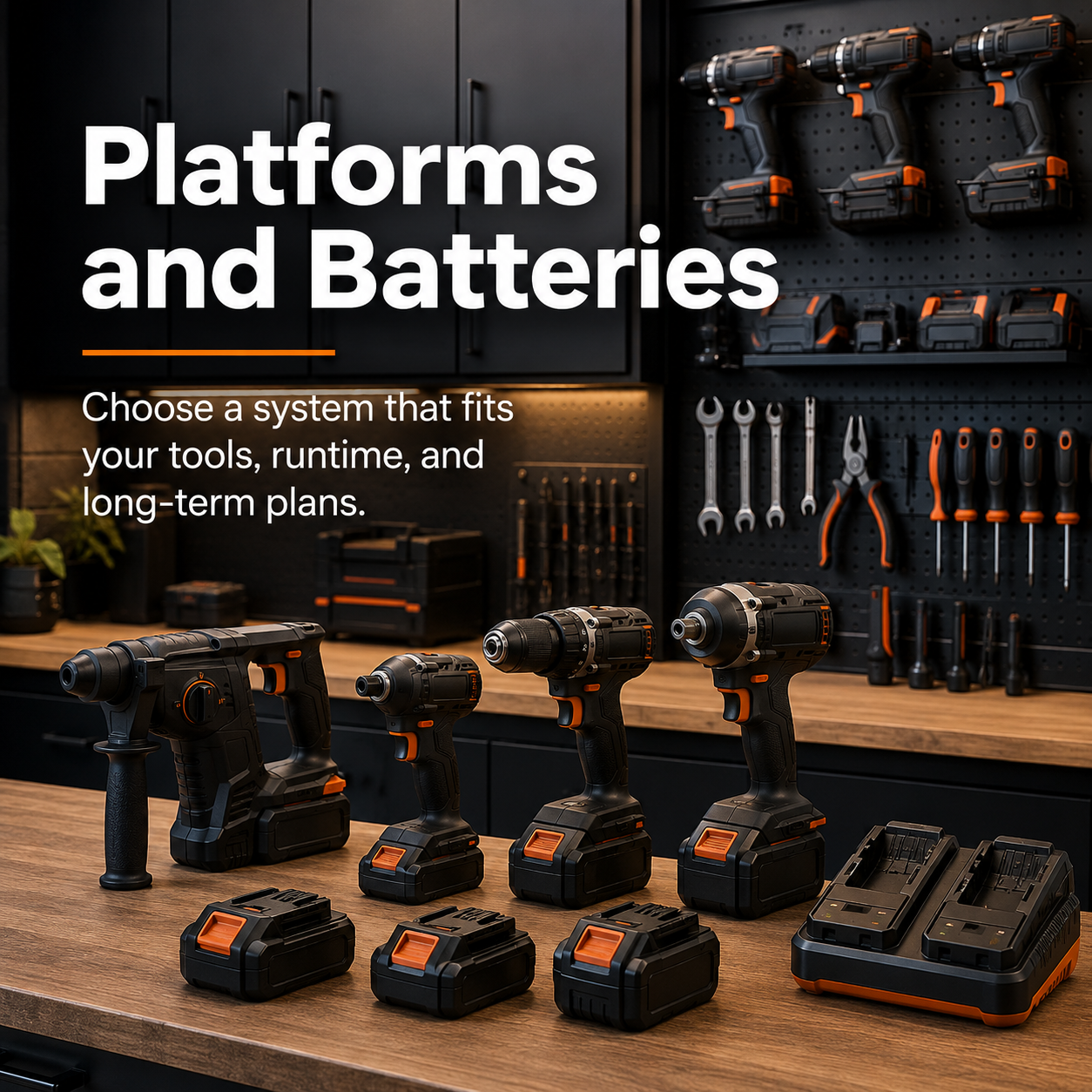
Platform planning in practice
That is why the first platform choice matters more than the first bare tool. A decent system keeps later saws, lights, inflators, vacs, and storage decisions coherent instead of expensive and messy.
The first cordless purchase usually feels like a drill decision, but the real decision is battery compatibility. Once you own two batteries and a charger, every future bare tool starts looking cheaper and easier to justify. That is the trap and the advantage.
If the platform fits your actual work, expansion gets cleaner over time. If it does not, you end up with mismatched chargers, the wrong battery sizes, and a tool lineup that never quite supports the projects you actually do.
Start with the homeowner or serious-DIY platform guide, then move into the brand comparisons. Use the starter-kit and battery-planning pages before you buy extra packs or a bigger kit than you actually need.
This sequence keeps buyers from treating a battery ecosystem like a random aisle impulse instead of a long-term garage system.
| Platform | Best fit | Biggest strength | Watch-out |
|---|---|---|---|
| Ryobi 18V ONE+ | Homeowners, casual DIYers, budget-conscious garage users | Huge range of affordable home, yard, cleanup, and project tools | Not the best fit for heavy daily use or the most demanding specialty-tool lanes |
| DeWalt 20V MAX | Homeowners who want a tougher prosumer platform | Strong mainstream pro and prosumer coverage, easy retail availability, strong drill/driver and saw lineup | Costs more than value-first platforms and the branding can confuse buyers into thinking 20V automatically means a different class of system |
| Milwaukee M18 | Serious DIYers, home mechanics, buyers chasing premium breadth | Deep pro ecosystem, strong specialty tools, strong overlap with PACKOUT and M12 | Often more platform than occasional homeowners really need |
| Milwaukee M12 | Compact work, mechanic tasks, tight-space installs, second-platform strategy | Excellent subcompact ecosystem for ratchets, compact impacts, installation tools, and lights | Not a full replacement for a main 18V or 20V platform if saws and higher-demand tools matter |
| Makita LXT | Woodworking-leaning DIYers and buyers who care about ergonomics | Mature 18V system with broad tool coverage and refined day-to-day feel | Can be less visible at some U.S. retailers than Milwaukee, DeWalt, or Ryobi |
| Makita XGT | High-demand tools, larger saws, more advanced workshop loads | Higher-power system for buyers pushing beyond normal homeowner-level demand | Usually overkill as a first platform for a normal home garage |
Value-first lane
Good for homeowners who want a real platform without paying premium-brand tax on every future add-on.
Balanced prosumer lane
It stays easy to buy locally and covers the normal garage tool path well.
Premium expansion lane
Best for serious DIYers, home mechanics, and buyers who care about deeper specialty-tool coverage.
Compact second-platform lane
Great as a mechanic-leaning companion system, weaker as a full garage-only replacement for 18V or 20V.
Ergonomics and feel lane
Especially attractive when repeated use matters and tool feel is part of the decision.
High-demand lane
Useful once the garage is becoming a more serious shop, unnecessary for most normal homeowners.
Common mistakes
A cordless tool platform is a shared battery, charger, and tool ecosystem built around one system rather than one individual tool purchase.
Most homeowners should start with one main 18V or 20V-class platform and add a second platform only when a real compact-tool or specialty-tool need shows up later.
Not automatically. Many 20V MAX systems are 18V nominal in normal use, so the better decision is based on tool fit, battery options, ergonomics, and ecosystem depth instead of label marketing alone.
Ryobi is often the easiest value-first homeowner platform, DeWalt is a strong prosumer step-up, and Milwaukee fits buyers who genuinely want a deeper premium system.
Yes. Batteries affect runtime, weight, charger clutter, future bare-tool buying, and how expensive it becomes to expand the platform later.
This page was built from the Garage Bench Co. cordless platform cluster handoff and adapted into the live site template so the guidance stays buyer-fit focused, cluster-linked, and practical for real garages.
Read next
If you are still deciding between a value lane and a stronger long-term system, the fastest next move is the homeowner platform guide.