Stage 1
Drill/driver
The first core tool for almost every homeowner because it covers drilling, pilot holes, hardware, and light fastening with control.
Garage Bench Co.
Serious DIY garage workshop guidance
Cluster hub
Most garage users should start with a drill/driver and impact driver, then add hammer drills, impact wrenches, cordless ratchets, compact kits, or tight-access tools only when the actual work justifies them.
Written by
Garage Bench Co. Editorial Team
Updated
May 10, 2026
Best use
Use this hub before buying the wrong first core cordless tool or confusing tool names that solve very different jobs.
Quick answer
Most homeowners should start with a drill/driver and impact driver, then add specialty tools only when a real garage, mechanic, masonry, or tight-access job shows up often enough to justify them.
Who this guide is for
Homeowners and serious DIYers deciding which core cordless tools belong in the garage first.
The Garage Bench Co. angle
This hub turns a confusing wall of drills, impacts, wrenches, ratchets, and compact kits into a practical buying path for a real home garage.
Tool choice gets messy fast
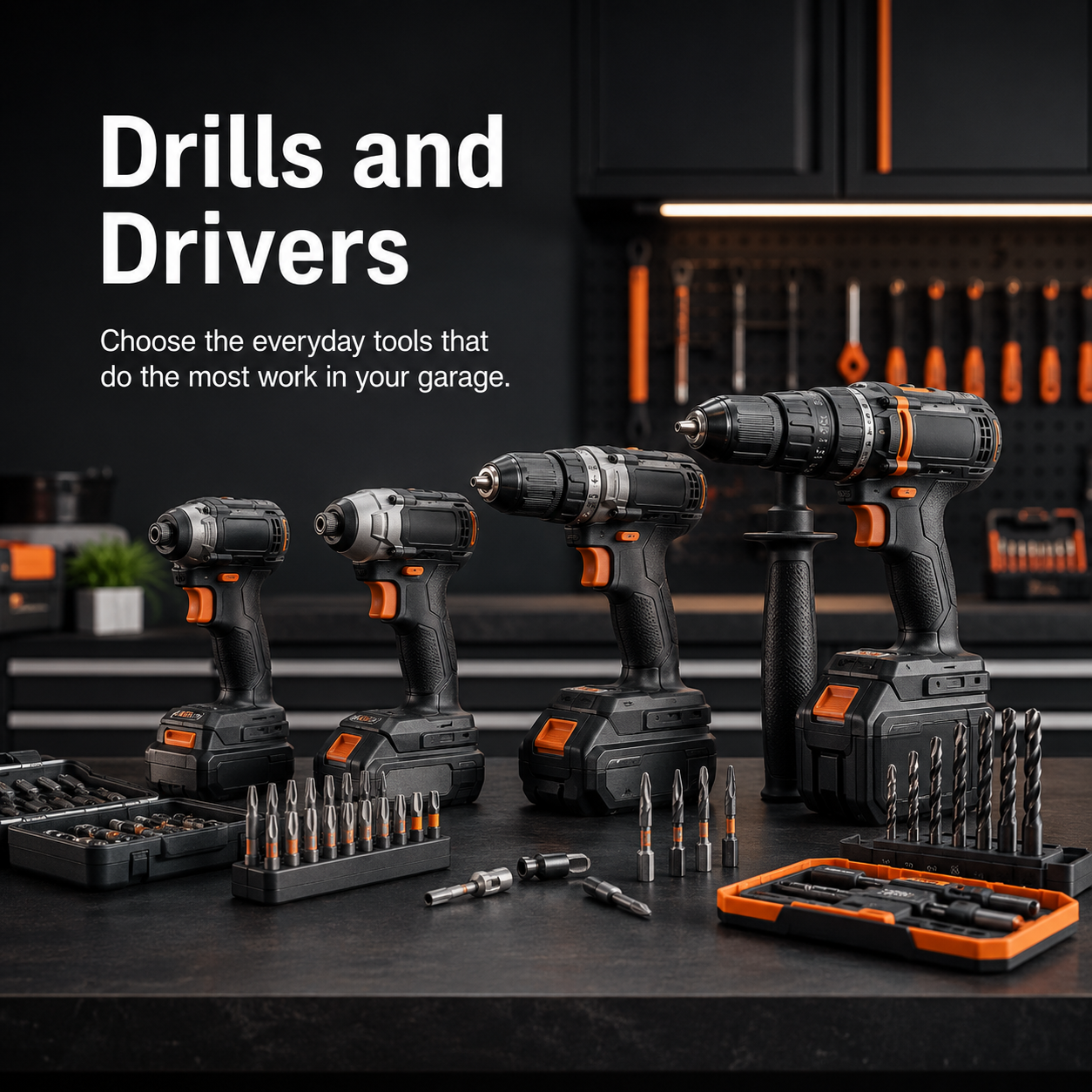
Drills, impact drivers, hammer drills, impact wrenches, and ratchets overlap just enough to confuse almost everyone. The cleaner buying path is to ask what you need to do, then let that job decide the tool.
Most confusion in this category comes from names that sound similar while solving very different problems. Drilling clean holes, driving deck screws, boring into masonry, removing lug nuts, and running bolts in tight spaces should not all point to the same purchase.
If you buy by job type first, the category gets simpler fast. A drill/driver handles general drilling and controlled fastening. An impact driver speeds through screws and lags. A hammer drill earns its keep when masonry shows up. An impact wrench is for automotive nuts and bolts, not wood screws. A cordless ratchet is a speed tool for tighter spaces, not a breaker bar replacement.
For most garages, the practical buying order is drill/driver, impact driver, batteries, charger, good bits, and simple storage. After that, the specialty tools should be earned by repeated need.
That means hammer drills, impact wrenches, ratchets, compact kits, and right-angle drills are usually smart second-wave buys, not automatic first-cart additions.
Stage 1
The first core tool for almost every homeowner because it covers drilling, pilot holes, hardware, and light fastening with control.
Stage 2
The second tool most DIYers wish they bought sooner once deck screws, brackets, longer fasteners, and repetitive driving show up.
Stage 3
Add hammer drills, impact wrenches, ratchets, compact kits, or right-angle tools only when the jobs become real and repeated.
| Tool type | Best for | Not for | Garage Bench Co. take |
|---|---|---|---|
| Drill/driver | Drilling holes, driving smaller screws, using clutch control | High-volume fastening into framing lumber | The first core tool for almost every homeowner. |
| Hammer drill | Drill/driver work plus occasional masonry holes | Replacing a rotary hammer for heavy concrete work | Worth it if masonry or heavier drilling is realistic. |
| Impact driver | Driving screws, lag screws, deck fasteners, construction-style fastening | Precision torque or drilling clean holes | The tool most DIYers wish they bought sooner. |
| Impact wrench | Lug nuts, suspension work, large nuts and bolts | Wood screws or delicate fasteners | Buy for automotive and mechanic work, not general DIY screws. |
| Cordless ratchet | Running nuts and bolts in tight automotive spaces | Breaking heavily seized fasteners loose | A speed tool, not a breaker bar replacement. |
| Right-angle drill | Tight-access drilling and driving | General first-drill duties | A specialty tool after the basics are covered. |
| Compact drill and impact kit | Overhead work, tight spaces, light-to-medium tasks | Heavy boring and large structural fasteners | Often better than flagship tools for real garage comfort. |
Tool type
Choosing the right category matters more than chasing the most impressive number on the shelf tag.
Battery platform
The right tool matters, but the platform decides long-term convenience, cost, and charger clutter.
Control
Good control prevents stripped hardware, damaged material, and tools that feel annoying to use.
Size and weight
A slightly smaller tool that feels easy overhead or in cabinets often beats a flagship spec monster.
Accessory fit
The tool is only part of the system. The supporting accessories decide how usable it stays day to day.
Safety
Binding, overdriving, stripped fasteners, and poor control show up before many buyers expect them.
Mistake 1
More torque is not automatically more useful if the work is mostly shelves, repairs, and normal garage tasks.
Mistake 2
An impact driver is not an impact wrench, and an impact wrench is not a precision fastening tool.
Mistake 3
Bits, sockets, batteries, chargers, and simple storage affect the real ownership experience more than buyers expect.
Safety notes
A drill/driver is usually first, but a drill and impact driver combo kit is the best practical starting point for most people.
Most DIYers benefit from owning both because they solve different problems.
It is worth it if you drill masonry or want a tougher all-around drill. It is not a substitute for a rotary hammer in heavy concrete.
No, not reliably. For lug nuts, look at an impact wrench and always finish installation with a torque wrench.
Yes for many garage tasks. Compact tools can be easier to control and less tiring than flagship tools.
This page was adapted from the Garage Bench Co. core drills cluster handoff and fitted into the live site template. It keeps the decision centered on buyer fit, real garage use, and cleaner tool sequencing instead of one-tool hype.
Read next
That comparison solves the most common starting-point confusion in this whole cluster.